
Markets aren’t cold, rational calculators. They are massive aggregations of human hope, panic, and structural positioning. When an asset drops 20% in a week, the underlying business or protocol rarely changed 20% overnight; what changed was the collective psychological risk tolerance of the participants.
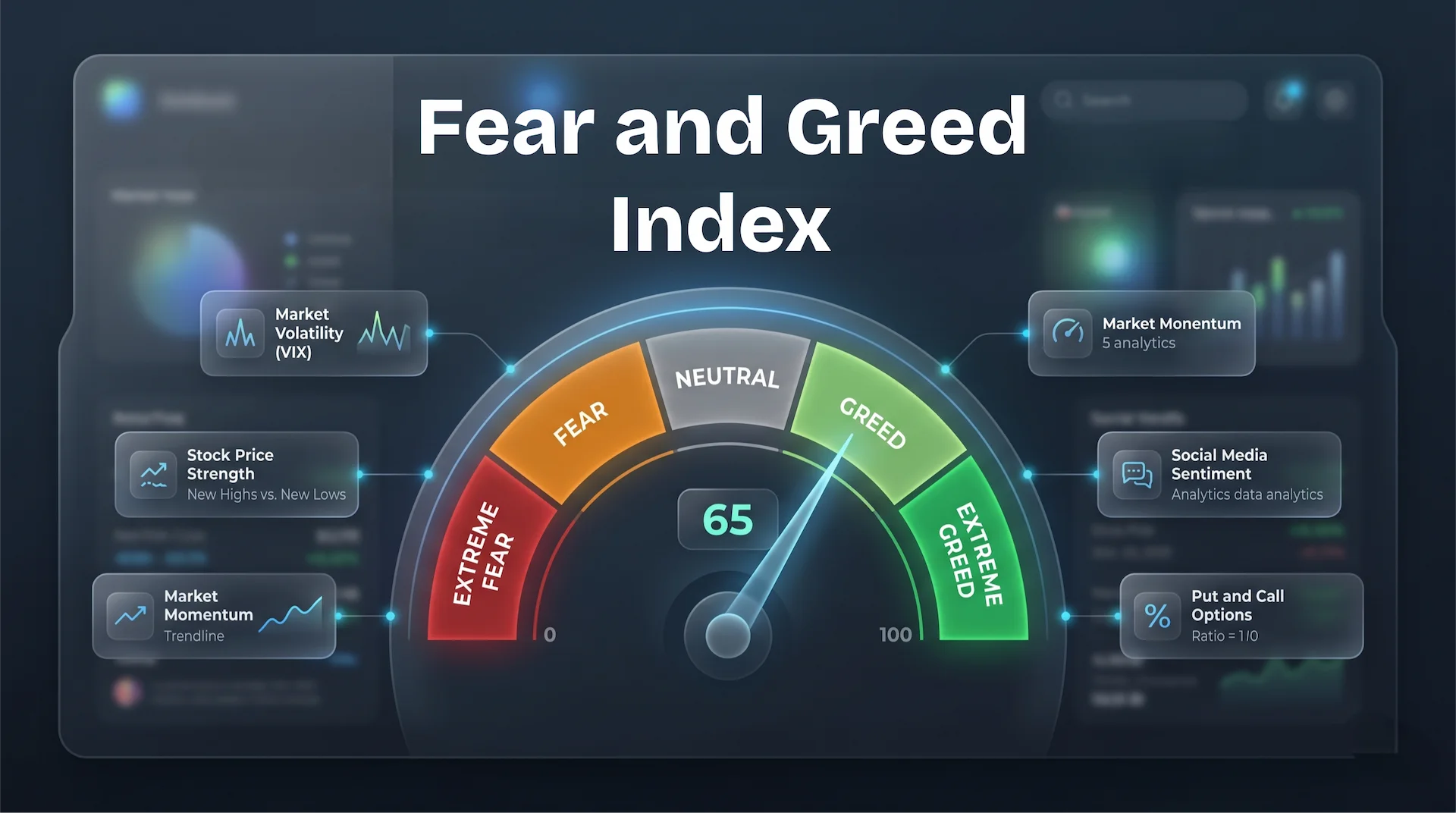
This emotional pendulum is exactly what the Fear and Greed Index attempts to measure. While many retail traders view the index as a casual dashboard or a gimmick to glance at before opening a trade, its plumbing relies on hard market data. It strips away the noise of talking heads and distills sentiment into a single, standardized metric between 0 and 100.
To use it effectively, you have to understand the mechanical components that move the needle, how the data is processed, and exactly where the index fails.
The Anatomy of Sentiment
The concept behind the scale is uniform across asset classes:
- 0 to 24 (Extreme Fear): Market participants are universally risk-averse, leading to panic selling and structural capitulation.
- 25 to 44 (Fear): General uncertainty dominates; investors hesitate to deploy capital.
- 45 to 55 (Neutral): A rare equilibrium where buying and selling pressures balance.
- 56 to 74 (Greed): Rising asset prices fuel FOMO (fear of missing out), and risk management begins to slacken.
- 75 to 100 (Extreme Greed): Euphoria peaks, leverage builds up, and valuations disconnect completely from historical averages.
What surprises many people is that there isn’t just one universal index. The two dominant models operate under completely different hood configurations: the traditional equities index (pioneered by CNN Money) and the digital asset variant (adapted by platforms like Alternative.me).
How the Stock Market Index Works
The traditional equities Fear and Greed Index tracks seven core pillars of the U.S. stock market. Rather than relying on opinion polls, it measures how much these seven indicators deviate from their historical averages.
1. Stock Price Momentum
This measures the closing price of the S&P 500 relative to its 125-day moving average. When the index tracks significantly above this line, it signals greed. When it plunges below, fear dominates.
2. Stock Price Strength
This pillar looks at market concentration by counting the number of stocks on the New York Stock Exchange (NYSE) hitting their 52-week highs versus those hitting 52-week lows. A healthy bull market features broad participation. If only a tiny handful of mega-cap stocks are keeping the index afloat while the majority hit new lows, the metric skews heavily toward fear.
3. Stock Price Breadth
Using the McClellan Volume Summation Index, this component analyzes the trading volume of advancing stocks versus declining stocks. High volume on down days indicates systemic liquidation (fear), while high volume on up days shows aggressive accumulation (greed).
4. Put and Call Options
Options data provides a clear look at how investors are hedging. The Chicago Board Options Exchange (CBOE) put/call ratio is monitored daily. A baseline ratio above 1.0 means traders are buying more protective puts (bearish bets) than bullish calls, signaling a defensive, fearful market posture.
5. Market Volatility
This tracks the CBOE Volatility Index (VIX) along with its 50-day moving average. The VIX measures the implied volatility of S&P 500 options. Spikes in the VIX mean options traders expect violent price swings, a classic hallmark of market panic.
6. Safe Haven Demand
This gauges asset rotation. The metric tracks the difference between stock returns and U.S. Treasury bond returns over the trailing 20 business days. When equities underperform safe-haven bonds, it shows institutional capital fleeing riskier profiles for safety.
7. Junk Bond Demand
This analyzes credit risk. It measures the yield spread between high-yield (junk) bonds and investment-grade corporate bonds. A narrow spread means investors are willing to accept low yields for highly risky debt—a clear indicator of extreme risk-on greed. A widening spread means bond investors are demanding a massive premium to take on default risk.
The Crypto Variant: A Different Beast
When engineers adapted the sentiment framework for digital assets like Bitcoin, they realized that credit spreads and treasury bonds didn’t apply. Instead, crypto requires a blend of behavioral metrics and raw blockchain data.
The calculation typically breaks down across these five weights:
| Component | Weight | What It Tracks |
| Volatility | 25% | Current price deviations relative to 30-day and 90-day averages. Sudden spikes act as a proxy for panic. |
| Market Momentum/Volume | 25% | Daily buying volume compared to historical baselines. High volume in an upward direction signals greed. |
| Social Media Sentiment | 15% | Text processing and scraping algorithms that track hashtag volume, engagement rates, and speed of interactions on networks like X and Reddit. |
| Bitcoin Dominance | 10% | Bitcoin’s share of the total crypto market cap. A rising dominance shows capital rotating out of volatile altcoins into a relative safe-haven asset, indicating fear. |
| Search Trends | 10% | Google Trends data for highly specific search terms. A shift from “how to buy Bitcoin” to “Bitcoin crash” structurally resets this weight. |
The Mathematical Layer: Normalization
The magic of the index isn’t just in gathering this raw data; it’s in the normalization process.
If the VIX hits 30, that number alone doesn’t mean much without context. The index converts that raw number into a value from 0 to 100 by calculating how many standard deviations the current reading is from its historical mean.
Each of the components is scored independently on this scale. The system then takes an equal or custom-weighted average of those scores to generate the final daily reading.
Where Amateurs Get Wrecked
The most common mistake traders make is using the index as a momentum indicator. When they see the gauge hitting 85 (Extreme Greed), they jump in because “everyone is bullish.”
In reality, the index functions best as a contrarian signal. Legendary investor Warren Buffett summarized this dynamic: “Be fearful when others are greedy, and greedy when others are fearful.”
[Extreme Fear]  --> Asset Prices Under Valued --> Potential Buy Zone
[Extreme Greed] --> Leverage & Euphoria Peak  --> Potential De-Risk Zone
The major trade-off here is timing. An index can remain anchored in Extreme Greed or Extreme Fear for months at a time during strong macro-driven trend cycles. This works beautifully until the trend snaps. If you short an equity index the absolute second it touches a greed score of 80, you run the risk of getting run over by a multi-week momentum rally before the top actually sets in.
Execution: Catching the Turns
Because sentiment can turn overnight on a single macroeconomic report or regulatory headline, tracking these numbers manually is an operational bottleneck. Constantly refreshing dashboards usually leads to reacting after the market has already moved.
To solve this friction, platforms like Fear Greed Live automate the process by monitoring these data shifts and pushing instant notifications directly to where you actually spend your time. Instead of managing manual workflows, you can configure rule-based triggers to alert you across multiple communication nodes:
- Telegram & Discord: Immediate alerts pushed to personal channels or trading groups when the index enters extreme zones.
- Slack: Direct workspace integrations to keep long-term portfolio strategies aligned without leaving your work environment.
- Email & In-App Notifications: Structural daily digests or instant threshold alerts to capture massive sentiment pivots.
Automating these touchpoints removes the emotional friction of execution, turning raw psychology into a clean, actionable data feed.
The Takeaway
The Fear and Greed Index shouldn’t be used as a standalone green or red light to enter a trade. It won’t tell you exactly when a market will top or bottom out. Instead, look at it as a reality check against your own biases. When the crowd is screaming for a market crash and the index hits single digits, that is historically the exact moment you should be looking for high-quality assets trading at a deep structural discount.